Musings + Stuff

This is where I drop my most pressing thoughts, ideas, and resources. 

How to Investigate & Challenge Your Mindset in Sobriety

The Two Mindsets

In her book "Mindset: The New Psychology of Success," psychologist Carol Dweck explores mindset theory. Dweck and her colleague's study that people either have a fixed or a growth mindset. Our perspective is much more powerful than we might even realize; my goal with this post is to empower you to learn about your attitude and grow your mindset in sobriety. You begin this by admitting you have the power to change your mindset and change your life. The two perspectives can determine a great deal about you. Learning about these mindsets and surrendering to the growth is expansion. 

The Growth Mindset believes you can cultivate and grow through your efforts and ask for help when needed. The Growth mindset lets us see that anyone can be anything, and anyone with the motivation and application can become whoever they want to be. The growth mindset creates a solid devotion to learning. 

Creating a growth mindset in sobriety is about challenging failure by praising your efforts with grace and self-compassion. 

The other side of the coin is the Fixed mindset is where you may believe that your skills and qualities are designated. The Fixed mindset creates an urgency for you to prove yourself repeatedly. You think you only have a fixed amount of intelligence, a specific personality, or moral character within this mindset. You must constantly prove you have the amount you have. A fixed mindset is a thought that we are given what we are given, and that's it, no more, no less.  How do we get a fixed mindset, you might ask—We have adopted the belief that we are all we will ever be.

Limiting Beliefs
Limiting beliefs are assumptions you may have created over time about yourself and how the world works. They are individual truths that guide your behavior and actions. Your experiences and your conditioning build this mindset. It could be something your parents had told you repeatedly when you were younger, or a general view shared within the culture in which you grew up. 
Our limiting beliefs (also called a fixed mindset) act as an excuse not to do something and protect ourselves from something terrible. They can hold us back from what we want. 
Instead of letting limiting beliefs stop us from taking action, we can identify them, analyze them, and ultimately strip them of their power using positivity and possibility. 


3  Limiting Beliefs that could be holding you back⇢

01. Fear of Failure- This one shows up as fear. Fear that you can't do something that is out of your grasp.
In sobriety, you may feel it is impossible, so you limit yourself by thinking you will fail or won't be good at it. The fear of failure can keep you from even trying to stop drinking.
 
02. Fear of Success- This can show up as you fear hurting another's feelings, like a family member or a partner, so you stay where you are. You may succeed in work or sobriety and begin thinking you won't make another milestone or success.  
If you are successful in sobriety, you may fear life changes like losing friends or community. 

03. Scarcity - Scarcity is the fear of not having enough within the world for you. You think everyone else gets a share except for you.  
 
4 Ways to Challenge Your Beliefs ⇢

01. Identify the Limiting Belief. The limiting belief is the thought or idea keeping you stuck in the belief loop. Your limiting beliefs will be the thoughts that are recurring for you. The one that keeps you stuck or not moving ahead. In sobriety, a limiting belief may be that you won't be fun anymore...which isn't true!

02. Analyze + Challenge the belief. What evidence is there (or not there!) that
makes this belief accurate? Can you know whether it is true, or do you believe it to be accurate based on past experiences? Where did you pick this belief up along the way?

03. Strip the Belief of its Power Explore the belief by reversing it. We do this by creating or stating the new idea - use an affirmation or mantra to support you. 
An example would be "I am growing every day" or "I am allowed to be a work in progress." 
Create affirmations that help reverse your limiting beliefs. 

04. Be Compassionate With Yourself. Being compassionate with yourself is key to having a growth mindset. Rather than visiting setbacks as a failure or a sign that you cannot execute sobriety, try to learn from the experience. In the future, as you grow and move forward, you will have the tools to overcome challenges and continue your recovery journey.


Making these changes requires a certain mindset. You need to open your mind to the possibility of personal growth and recovery and believe that you can do it. Otherwise, you may find yourself stuck in the same thought and behavioral patterns that caused you to turn to drugs and alcohol and be frustrated with your inability to overcome them.


I am sending you the best as you investigate your mindsets and challenge your limiting beliefs. 
xx, Heidi 


The image below is from Carol S. Dweck, Ph.D. Mindsets: The New Psychology of Success. It helps explain the Fixed and Growth mindsets even further. 


Respect The Road That Got You Here.

Gratitude In the Face of Shame

I cried when I brought my daughter home from the hospital after she was born. Although I had prayed for her for a very long time, I felt incapable and not worthy of being her mom. How would I give this person the guidance and love they needed when I didn't even love myself? When I look back on this, I feel deeply for that young woman and all she didn't give herself credit for. I call this a story because it doesn't feel real now that my daughter is a 14-year-old lady!

The feelings of incapability as a mom continued to grow and grow as I had my son and abandoned my health and my needs. I was drinking to escape, yelling to control, and withdrawing to avoid feeling. This continued self-sabotage created a life of disconnect and self-loathing.  

I beat myself up daily for years, dragging up all the abuse I put my body through and the wasted time I spent drinking. This looked like barely listening to their voices as they yelled MOM, sang silly songs, and asked me to look at something again and again. Instead, I stayed angry, full of shame and guilt that had me running to drink repeatedly until I couldn't anymore. ALL of this was something I often regretted. I convinced myself it was always going to haunt me. 

My thoughts circled about the countless times I drank before volunteering at their school, how much I drank to cook them a meal, the secret drinks in my coffee mug at their sporting events, and the sneaky bottles of wine I bought to drink on my way home. The shame and guilt were heavy and crippling. I figured I deserved it. I had to pay a penance for my actions. 

As I continue my journey, a growing desire has flourished deep within my heart space. A hunger to BE, with all my flaws, and wearing the bumps and bruises from the past with pride. As I release my past, I trust that it is possible to start again, start now, creating a life that I love. Let's do this. Let's be ourselves and wear our past with gentleness and so much pride that we burst with love. 

Today as a Sobriety + Lifestyle Coach, I support women as they release shame + begin anew with confidence + self-compassion in sobriety.  

Now, I send hope for this message to you that you accept the changes rushing toward you, although it may be heavy and feel impossible to release the past. That when you do, you will be granted the opportunity to grow. As I write this, I am reminded by the writer and poet Cleo Wade, "If you are grateful for where you are, you have to respect the road that got you there." 

Your past doesn't dictate your future, my love. You don't have to live there anymore. 

I send you hope and comfort as you find even a sliver of appreciation for your story then and now. All of it has led you right here. 

x, heidi 

You Can Control Your Anxiety!

3 Easy Ways to Control Your Anxiety Right Now

Chronic anxiety is a sign that your nervous system needs love! 

I hear clients how anxiety can negatively impact their goals, life, sleep, and more. It can affect our lives. These anxiety solutions below are tools for your anxiety toolbox. You may not use them all the time, and you may only need one or heck, you may need them all! 
I encourage my clients to experiment, try a method for size, and remove it promptly if it doesn't light them up! 
 It may take you trying a technique a few times before you can tell if it's right for you & this is perfect and lovely. 

80% of your vagal nerve fibers communicate from the body to the brain- this is why I tell my clients to get into their bodies and notice the sensations.

Please pick one strategy below, try it, and NOTICE what happens. When I say notice, I mean did you like it? Was it easy? Did it seem odd? Did you feel tingly or any other sensations? Did you feel sick to your stomach? I want you to notice ALL OF IT.
What you notice is all the data points for our growth. This also empowers you to decide what you like and what doesn't work for you! 
(think of the Runaway Bride scene and her trying all the eggs to see which ones she likes)

I do want to mention that some anxiety is good. It may convey a message, motivating us to change or adjust as needed. We can typically check in with our soul or intuition at this point and ask what the anxiety is trying to tell us.

One way we help control our anxiety is by activating the Vagus Nerve. 
The vagus nerve- runs on the left and right sides of your body. This nerve bundle consists of the longest nerves in your body and travels from the base of your brain down your body and into your abdomen, attaching to almost every major organ, including the heart, along the way. The Vagus Nerve holds onto stress.

The vagus nervous activates your gut and brain, and it needs to be toned or stimulated so it can regulate your nervous system and provide you a sense of calm. 

Stimulating the vagus nerve helps induce relaxation and produce feelings of calm, aids in digestion, decreases stress, + improves your mental well-being.  When you activate your vagus nerve, you turn on your relaxation response, which helps you feel calmer + in control.

Here are 3 ways you can tone the Vagus Nerve: 

1. Chanting + Singing- Your vocal cords are connected to your vagus nerve. So using them helps to stimulate it. 
Some of the best ways to increase vagal tone with your voice are singing, humming, or chanting. Give it a try and you’ll see you instantly feel uplifted when you sing.
Singing, humming, + chanting is also known to release the stress hormone cortisol in your body.  Voo chanting is from the well-known trauma therapist Peter Levine. When you exhale, begin chanting the "voooo" sound, and direct your breath into your belly.
  • Try VOO chanting to help stimulate your vagus nerve or sing as loud as you can in the shower. (link below)

2. Focus on the Exhale with Deep + Slow Breathing. Deep  + slow breathing has been shown to reduce anxiety and activate the nervous system part that helps us digest + rest. 

Try breathing in deeply from your diaphragm. When you breathe like this, your stomach should expand outward. Your exhale should be long and slow. Breathing deep + low increases the supply of oxygen to your brain + stimulates the vagus nerve, which promotes a state of calmness. It also grounds you in your body + brings you to the present moment. We are tricking our body into thinking it is calm.

3. Move Your Body!
A conscious exercise routine has been shown to stimulate the vagus nerve. Exercise is good for our mental health + gut flow because it activates our vagus nerve.  
*Reminder to Take it easy; too much exercise can stress your body more and release coritsol. 

Practice your favorites + your nervous system can support you when you need it the most.

Let me know what solution you tried and any thoughts about it. 
xheidi

Why You Should Focus on Improving Values In Sobriety

What are values?
Why are they essential in sobriety + recovery?
Have you thought about your values and how they can be part of your personal growth? 

 I believe values are our guideposts, our North Star of how we want to show up in this world. For most people, their lives are generally more comfortable and satisfying when they can identify their values and lean on them to make choices and actions honoring their values, which supports stepping into your power and living an authentic life. 


 When in active addiction, our values can fall to the wayside. We may be preoccupied with being accepted by others, wanting to feel better, or covering up what we have done to get a drink or drug. In recovery, we may choose to recommit, recreate, or reinvest in our values to help us stay on track of sobriety and growth.  Our values can empower us while creating a life we love. Creating or Reinvesting in your values is an act of self-love and compassion for yourself. Feelings of guilt and shame have no place when doing this heart-centered work. 


 When we are in this place of growth, some feelings of guilt and shame may surface from previous memories. If this happens, please know you are not there anymore; you are creating a new pathway here as you recommit to creating a life you love.  As hard as it may seem, stay here in this moment of guilt + shame; although painful, your empowerment starts here. There is no judgment, just learning to sit with it and fostering self-compassion. Leading with compassion is the key. Your self-compassion will only aid your healing. 

 In my Values Mastermind Course, I offer a space for calling on grace and kindness.  Whether you are recreating or initiating for the first time a list of values, being present, listening, reading, writing, I suggest getting into your body to notice what alignment feels like.

I suggest taking a moment to listen to this beautiful mediation from Sarah Blondin on Grace & Kindness from her book Heart Minded and notice. Is there fear, doubt, apathy, or did those limiting beliefs and negative self-talk take over? Use the meditation as much as you need until you leave with kindness + grace.  

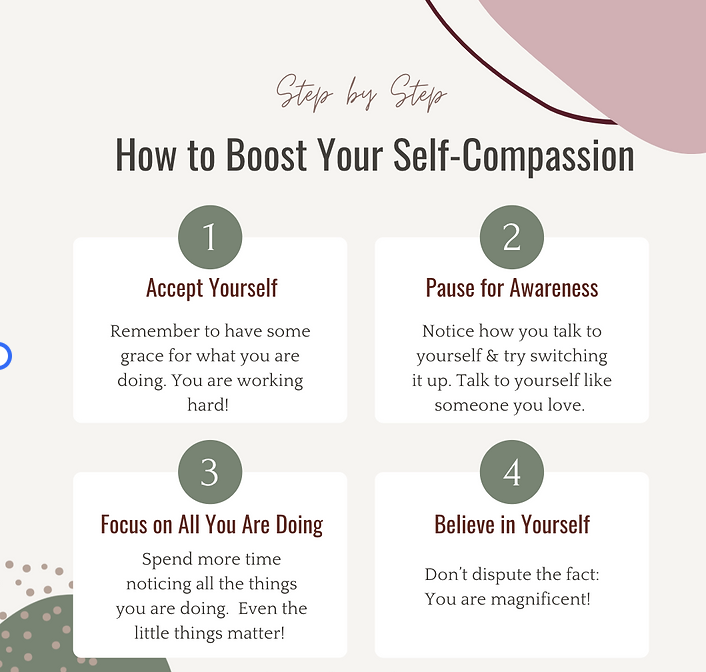
Step by Step: How to Boost Your Self-Compassion

The act of self-compassion can seem out of reach, and yet it’s so freeing!  Many of us have had many years of conditioning. Conditioning can look like self-induced limiting beliefs or pushing ourselves to achieve and succeed so much that self-compassion can seem weak. 

This comes up a great deal with my clients & within myself.  
We all try things, and it doesn’t go how we want it to, so we label ourselves failures + wow! That critical babble can be so mean! 

These short, easy steps below will help when you need to lean into self-compassion and grace a little more. 

  1. Accept Yourself: Remember to have some space for grace for what you are doing. I urge you to focus on your exceptional qualities and accept those unique things about you. They make you, YOU! 
  2. Pause for Self Awareness: Taking pauses to notice how you talk to yourself and try switching it up. Talk to yourself like you would someone you love, a baby, or your pets. Our inner critic is one hot mess and can bring us down if we let her rule all of our thoughts. 
  3. Focus on What You Are Doing: Spend more time noticing all the things you are doing and all the hard work you are doing—even the most minor things matter.  One exercise I give my clients who struggle with seeing all they are doing is to take a few minutes each night and switch your focus from all you didn't get done to all you DID do. Write down those 5-10 items that you did get done. Deep breaths + showers count. 
  4. Believe in Yourself: Let's not dispute the fact that you are magnificent. You are a unique soul with so much to give this world. This means having faith in your capabilities. You can do so much more when you believe in your abilities.  This helps us overcome self-doubt. 
 

hugs + grace, 
Heidi

I Celebrate Progress Over Perfection

Celebrating progress can be challenging. Perfectionism is a struggle for many of us, me very much included. Unfortunately, my shame and guilt regularly smother the flames of success I work to cultivate. I even had a therapist tell me once that my perfectionistic tendencies wouldn't allow me to become dependent on alcohol. HA! 


When I was drinking, I tried hard to portray myself as a perfect mom, wife, daughter, friend, and woman who managed many folks at her military job. I needed to control other pieces and parts of my life since I was admitting, slowly and reluctantly, that my drinking was out of control. 
 
When I stopped drinking, I tried to perfect that, too. I needed to do it just like the others I followed, podcasts, and books told me.  I treated it like any other part of my life that I needed to do just right.  My goal was total abstinence, and any setback on that path felt like a complete failure. 


It took connecting with others on this journey to realize all of my work, regardless of what it looked like, counted as progress. All of the times I reduced my drinking was progress. When I thought I was about a drink and didn't do it, that was progress. All of it was progress. I continually learned that perfection isn't the goal, that celebrating any attempt was my new objective. 


Progress can look like so many things. During a very trying time in my second year of sobriety, I brought a bottle to my lips and didn't drink. Although I didn't drink, I felt at that moment that I was a failure. The memory of it flashed red-hot all over me for weeks until I allowed myself to sit and dig deep at the reasoning behind my actions that day. I realized that I was hurting and scared, and at that moment, that bottle felt like the only relief. I'd been in this exact place too many times to think. Only this time, I hadn't taken that drink. I'd wanted to, but I stopped myself. I saw it as progress. 


Today, I celebrate all of my progress, no matter how small or mighty. I celebrate a hot shower, a day with a few glasses of water, an attempt at meditation, and a day (okay, maybe an hour) without yelling at my kids. Every progression is a gift. 


There is a quote in the book The Gifts of Imperfection, by Brené Brown, that has become a daily reminder for me: "Yes, I am imperfect and vulnerable and sometimes afraid, but that doesn't change the truth that I am also brave and worthy of love and belonging."  


With all of my heart, I hope you remember this too!


Resources on Celebrating Progress + Perfectionism
  1. Listen to Beautiful Chorus Inner Peace  
  2. Write out at least ten things that you are proud of yourself for this week. Tip: try doing this in the morning before your ego wakes up! 
  3. Check out Gifts of Imperfection by Brene Brown  
  4. Here is a short guide with action steps on putting progress, not perfection, in play and how perfection may be hurting your productivity. 
  5. What is one thing you can try this week to let perfection fall away and perform without judgment? (write, paint, dance, garden, sing) 
  6. Celebrate your progress! I'd love to hear what you did to celebrate all the things you are trying below in the comments.